PBSCV1599

Gen. James Patton Anderson Camp 1599
Celebrating 34 Years 1992 - 2026
HISTORIC HOTELS
OF
PALM BEACH COUNTY
A look back at Historic Palm Beach County Hotels
ALBA
ALHAMBRA
AMBASSADOR (SEE ALBA)
ALMA
ARDMA (SEE PLAZA )
BIBA
BIG LAKE (SEE YORK HOTEL)
BILLOWS
BLUE HERON
BILTMORE (SEE ALBA)
BOCA RESORT
BOLLES HOTEL
BOYNTON BEACH HOTEL
BRADLEY HOUSE (SEE WHITE ELEPHANT)
BRADLEY PARK HOTEL (SEE WHITE ELEPHANT)
BRAZILIAN COURT
BREAKERS
BRIGGS
BUCKEYE (SEE VERA)
CARLIN HOUSE HOTEL
CHESTERFIELD (SEE VINETA)
CLINTON
COCONUT GROVE
COLONNADES
COOLNY (DELRAY BEACH)
COLONY (PALM BEACH)
DIXIE COURT
EARMAN HOUSE
EL NUEVO (SEE GULFSTREAM)
EL VARANO
ENOREE (SEE EVERNIA)
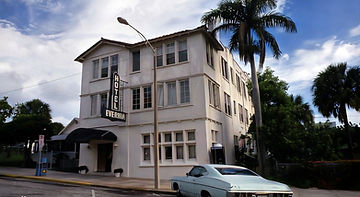
EVERNIA
FLORIDA HOTEL
FREELUND HOTEL (SEE VERA)
GEORGE WASHINGTON (SEE EL VERANO)
GULF STREAM
HEART OF PALM BEACH (SEE PALM HOUSE)
HELEN WILKES (SEE EL VERANO)
HIBISCUS
HOLIDAY INN "BEIUT"
HOLLAND HOUSE
HYGEIA
INN AT SOUTH PALM BEACH (SEE MIRAMAR)
KESWICK (SEE EVERNIA)
KYLE (SEE EVERNIA)
LAKE PARK HOTEL (SEE SEMINOLE)
LAKE VIEW (SEE RIVIERA HOTEL)
LIDO-VENICE (SEE VINETA)
KEYSTONE
MAYFLOWER (SEE ROYAL DENALI)
MIRAMAR
MONTE CARLO
MONTEREY
MT VERNON INN (SEE BIBA)
OAK LAWN (SEE RIVIERA HOTEL)
OCEAN VIEW
PALM BEACH HOTEL (OLD)
PALM BEACH HOTEL (NEW)
PALM BEACH HISTORIC INN
PALM BEACH SPA (SEE ROYAL DENALI)
PALM COURT (SEE VINETA)
PALM HOUSE
PALM LODGE APARTMENTS (SEE VERA)
PALMS
PLAZA
PLAZA INN (SEE WHITE ELEPHANT)
PENSYLVANIA
POINCIANA HOTEL
RIVIERA
ROSA MAY (SEE WHITE ELEPHANT)
ROSEMARY (SEE BRADLEY PARK)
ROYAL DENALI
ROYAL POINCIANA
ROYAL WORTH (SEE PENNSYVANIA)
SALT AIR
SEMINOLE
SEAGLADE (SEE BILLOWS)
VINETA
VERA
WHITE ELEPHANT
WHITEHALL
YORK








HISTORICAL NEWSPAPER ATICLES
Winter Journeys in the South: Pen and Camera Impressions of Men, Manners, Women, and Things All the Way from the Blue Gulf and New Orleans Through Fashionable Florida Palms to the Pines of Virginia
John Martin Hammond January 1, 1916
J. B. Lippincott Company
WINTER JOURNEYS IN THE SOUTH
PALMY PALM BEACH
THERE had been much talk in Ormond about " the train." You would be on the porch of the golf club and would see a balloon of smoke on the horizon. "What is that?" would say Big Sister from Chicago. "Why, that must be ' the train ' " would say the Mother of Big Sister from Chicago. And so it would go. Everybody seemed to know about this train and everybody seemed to be interested in it.
At last I was to see " the train." It came sneaking over the long bridge across the Halifax, rear end first, and settled with a sigh at the station of the hotel. Porters ran to the steps, tired-looking travellers came down those steps, a weary-looking conductor waved his arms languidly, energetic bell-boys grabbed hand baggage to run to the hotel with it. There was nothing remarkable about " the train" that I could see, nothing to justify so much talk about it, nothing remarkable whatever. However, one day at noon I boarded this train with the firm intention of going to Palm Beach. And thus I commenced another phase of my journeyings.
To get on the main line of rails from which it digresses to reach Ormond "the train" does some little jockeying, but at length we got started fairly south, and jogged comfortably along through an uninteresting country, accompanied always by an impressive cloud of white dust. Always this dust billowed and eddied outside of the windows and could be seen in swirls through the aisles of the cars. When the car stopped it settled in a discouraging fashion upon the habiliments of the passengers. There are few stops between Ormond and Palm Beach, at least " the train " made few. Occasionally we would halt at a siding or a water tank and then the passengers would get out, penetrate the envelope of white dust and stand beside the track. At one point where we alighted there was the longest stretch of straight track that I have seen anywhere. On, on, on into the horizon it proceeded, apparently without curve, and it maintained perfectly the laws of perspective. Then the train would start again. It had a peculiar way of starting,— this train; without warning whatever it would just quietly take up the burden of life once more and move. Other trains in other sections of the country make a dramatic moment of the start. There is a clatter, a clanging of bells, a waving of arms and the cry of "All aboard!" With this train there was nothing of the sort. It just went, and unless you were watching it you were very apt to be left behind. We reached Fort Pierce about half past seven in the evening, and immediately upon the hearing of this name there was a bright-ening upon the part of the passengers, for they knew that Palm Beach was not far away. "Palm Beach I" What a magic sound the name has! And what a wonderful scrubbing and dusting there was in the car with the porter as head priest of the movement. The porter dusted visibly. You could see each stroke of his brush on your clothing and a great cloud of white dust filled the air. However, he was through at last and we were all clean.
One should not talk flippantly about sacred things. Indeed, the magic of Palm Beach began to assert itself as soon as the train crept slowly out upon the bridge which connects the island with the mainland. The num-erous lights of the great Poinciana Hotel were reflected in the water; balmy, soft, Southern airs came through the windows of the train; there was a languorous, velvety feeling about the atmosphere.
Palm Beach, as almost everyone knows, is situated on the southern extreme of the Florida east coast, and is a narrow island about fifteen miles long and about two miles broad at its broadest point. It is separated from the mainland on which is situated the little village of West Palm Beach by a long, narrow sound, erroneously called "Lake Worth." On the eastern side it is bounded by the waters of the Atlantic ocean. The principal part of the island, speaking from the residential stand-point, is on the western side, or the lake front. Here stands the Royal Poinciana Hotel. Directly across the island on the ocean side is the Breakers, a hotel second in size only to the Poinciana. Adjacent to the Poinciana but farther north on the island are the Palm Beach Hotel and the Hibiscus, good houses both of them; the visitor may choose from any of these.
It is no place for a tired business man, or a retired business man for that matter. Indeed, I do not associate anything masculine with Palm Beach at all. It is soft, feminine. It is a woman's idea of a paradise.
To return, more particularly, to that immaculate throng which we left in the Pullman car under the direction of the colored porter,—the train creaked in its slow, non-committal fashion into the station of the resort, and stopped with a sigh. There was a bustle and confusion, but none of the babel one usually associates with railroad stations. I alighted under the porte-cochere, or whatever one may call the railroad entrance of a hotel. One porter grabbed the suit case containing my faithful camera, another porter took the bag containing my clothing and both together pointed to the steps which led to the main floor of the hotel. I ascended these, crossed a small porch and found myself facing a long corridor, down which I commenced to walk.
This was the longest corridor I had ever seen in my life, and I walked and walked. At last I began to get tired of this business; nothing but velvet footfalls, a sort of muffler padding as we tramped along. One quarter of a mile long is this corridor, the longest hotel corridor in existence.
At last we passed some lighted shop windows, went by an inviting, open, dining-room door and came to the nerve center of the hotel.And there behind the desk were the young men who dispensed the nerve of the establishment. I registered, giving my full name and previous condition of servitude, and was shown to a small room on the fifth floor. It took exactly ten minutes by my faithful watch, counting in stops for the elevator, to take on baggage, and to obey the traffic block signals, to go from the desk to my room. The room was small, without a bath, and was rated at six dollars a day, but it was clean and comfortable. The only thing I had against the room was its shape. Never have I seen a room of so unusual shape. The wall away from the one window formed a right angle with the floor; the wall in which the window was pierced formed a very acute angle with the floor and the other two walls had an angle which I have not been able to calcu-late. I could stand up comfortably against the wall away from the window, or I could stand up comfortably in the dormer of the window.
In the other parts of the room I crept like a villain for my clothes, and when I washed I crouched as if I were doing a dark and hideous deed, like Lady Macbeth trying to get rid of the spots.
Everything about the Poinciana must be calculated in terms of pure bulk. The house, when it is full to capacity, and it very frequently is filled, can accommodate fifteen hundred guests, and this figure does not include the number of the employees of the establishment.
The dining-room is made in two parts with a connection in the middle like the letter " H " and is big enough to house a regiment of soldiers. The menu here is of the same high quality and wide variety as in the other houses of the Florida East Coast Railway group. But the service is slow, no matter how good the waiter, as might be expected from the physical difficulties he has to contend with in so huge an establishment. Actually a dish may get cold in being brought from the kitchen to the table.
The popular dining hour at Palm Beach is 7.30 or 8 o'clock and the main aisle of either of the two dining-rooms is a resplendent vision at this time. The most gorgeous clothes and the most luxurious women in the country can be seen here, and the latest styles. This year the women seemed to run to bulk and the clothing to minuteness. Some other year the proportions may be reversed. There were big pearls, big diamonds and big jewelry of all kinds and assortments. One could not escape the sight of them.
Let me draw a picture of one characteristic diner at Palm Beach: Large, imposing she was, built by Titan upon Minerva's order. When we first saw her coming down the aisle she seemed to be carrying a bone in her teeth, to use the nautical phrase. She was striped in black below the water-line and was very neatly turned out above. When she sat at a table near me I learned from her accent that she was from the Middle West and when she came down the aisle she looked like a great vessel with a fair wind behind her. She was a ship of the American desert. Somewhere or other in her atmosphere there was carried along a husband like a fly outside a railway train window.
Time passes very quickly at Palm Beach, and it soon becomes the hour at which dinner is finished and the daily promenade begins in the long passageway outside of the dining-room and through the rotunda of the hotel. Imagine three or four hundred women gathered together and each one determined to slay the others with a pang of envy through the heart at the beauty of her attire! If one cares to sit by and watch this parade he may find many comfortable chairs scattered along the course.
As the evening wears on it becomes time for the dancing. This is done in a room down stairs in the "cafe," as it is called, chiefly peopled by the young of the female of the species. A negro banjo quartet provides the music, and very excellent music it is, too, done with that sense of primitive rhythm which distinguishes the black race. Here the young girls of the hotel are seen, and how beautiful these young girls are! Truly there is nothing finer than the young American girl. Slim as a rapier and quick as a flame! Dancing continues from nine to twelve o'clock and then everything is rigorously closed down.
It may be said here parenthetically that the percentage of real drinking at Palm Beach is very, very small. To begin with, on account of the laws of the state of Florida it is impossible to get anything spirituous to drink after six o'clock in the evening unless one has laid in a special private stock of his or her own. And the laws of the state, according to my observation, are very strictly enforced by the hotel. More than that, the air is too soft, too warm, to invite much indulgence in alcohol. It would be like drinking a cup of hot tea while sitting in a tub of hot water.
Bed time comes at the Poinciana neither earlier nor later than at other places. Very often the management of the hotel provides an entertainment in the main ball room or assembly room and this fills in the hour between nine and ten o'clock in the evening.
One of the amusing sights to be seen at almost any minute during the evening is that of the many reporters for New York newspapers and the fashion publications buzzing about the lobby or the corridors of the hotel interviewing guests, gathering names, and it is marvellous to observe the perturbation of some mother of a young miss as a representative of the mighty press bears down upon her.
"This is Mrs. Blank of Milwaukee?" "Yes, this is Mrs. Blank." "And Miss Blank is with you?" "Yes, Miss Blank is with me." "How long do you expect to stay?" "Oh, we'll be here the entire season,—" while the probab-ilities are no doubt that they will move on at the end of the week. And so it goes. No doubt there is much legitimate news to be gathered at Palm Beach. There must be. I should estimate the proportion of corres-pondents to guests as one correspondent to every twenty-five guests of the hotel.
The nights are cool at this great American watering place, and, if your room is properly screened, untroub-led by mosquitoes. If your windows are not so screened you will dream all night that Zeppelins are attacking your township.
Morning brings bright outdoors to Palm Beach almost every day, for rainy weather is not often known here. One ventures to sally forth, and is guided in his wanderings by a very useful publication put out by the hotel management, known as the Palm Beach Daily Program. What are some of the things that one may do during the day? Boating, bathing, fishing, walking, golfing, shopping, riding in the chairs. Riding in the bicycle chairs! Ah, there is something to do! Who does not remember the bicycle chairs at Palm Beach? One sits in a sort of a magnified baby carriage with a bicycle seat behind. A burly darkey occupies this seat and pedals vigorously. We rush violently through space, we round corners on two wheels. The small bicycle bells tinkle intermittently like fireflies of noise. It is an exciting thing to do.
Out of doors one gains a new idea of the bulk of the Royal Poinciana Hotel. It is conceived generally in the Georgian style of architecture and is a perfect barracks of a place, constructed of frame and clapboards. Not at all an unattractive building from the architect's standpoint, it is truly a monument to the bigness of grasp and enterprise of the founder of the whole chain of hotels on the east coast of Florida. Adjoining the Poinciana are the famous Palm Beach gardens, which contain many varieties of rare shrubs which can not be grown in Northern latitudes.
Connecting the Poinciana Hotel and the Breakers is a long straight avenue about one mile in length, down which run a track for wheel chairs.
The walk to the north along Lake Worth is the older and more popular walk at Palm Beach. Here are the shops and the tea-houses, and here is Bradley's, which may be given a more extended mention. The exterior of Bradley's, and the interior, for that matter, are as quiet as a country church. The atmosphere of the place is more that of a well-appointed, well-conducted home than anything else. Large sums of money are, no doubt, won and lost in this establishment, but I doubt if it altogether deserves quite the hectic reputation that has been ascribed it. Annually, stories come out of huge sums of money lost or won at this place; but spread over the whole period of its existence these sums would not be so very large. Anyhow, the question is not economically an important one. The money is lost usually by those whom it has cost nothing to obtain, and is merely removed from one idle channel of humanity to another. Let us continue to stroll farther on up the coast.
It was my good fortune to take this walk late one evening. Night was coming on, bringing that soft, slum-brous, tropic twilight. The vivid colors of a gorgeous golden sunset were reflected in the still waters of Lake Worth. To my right was the heavy green foliage of the palm trees, and in their shadows glimmered the white fronts of houses. Wheel chairs rustled swiftly by, tinkling as they went. The path seemed not to be solid, but seemed some airy walk shimmering in the half light, and leading on into a region of enchantment. Truly it was fairyland! One may well understand the continued charm of Palm Beach.
...................................................................................................................................................................
Palm Beach Daily News
Wes, Dec. 27, 2017
Page A1
By M. M. Cloutier
HOTELS OPEN IN 1924 WITH NEW YEAR'S EVE BASHES
“There will be a great problem to be solved in Palm Beach on the eve of the New Year.”
No, that’s not a current holiday-season pronouncement, but rather one by a local newspaper in 1924.
The mood was effervescent in a then-flowering winter resort town entering mansion-building boom, but there indeed was a perceived “problem.”
At issue: Among the wealthy winter denizens, collectively referred to as a “colony,” lay an enviable conundrum: In a discriminating see-and-be-seen social scene, which New Year’s Eve party was most promising?
That was a tough decision in 1924: The handful of coveted New Year’s Eve party venues — ranging from the Everglades Club to Standard Oil and railroad tycoon Henry Flagler’s Palm Beach hotels — were being elbowed by two newcomers.
And the opening-night galas of both venues? New Year’s Eve, promising “exclusive” and “gay and hilarious” fêtes with entertainment by such orchestra leaders as Meyer Davis.
One of the venues remains today, transformed; the other’s a former hot spot that drew the limelight and Prohibition raids.
Welcome to Whitehall and the Royal Daneli.
The former — the stunning 75-room mansion (now a museum) Florida developer Flagler gifted in 1902 to his third bride Mary Lily Kenan — was in transition in 1924 after years of the Flaglers as preeminent social hosts.
After Mrs. Flagler’s death four years after her husband’s in 1913, her niece Louise Clisby Wise Lewis inherited the manse and sold it to a group of investors, including an executive of Flagler’s hotel company, newspapers reported.
It was then announced Whitehall would be an “exclusive residential center” with “suites and apartments engaged” by the socially prominent.
Meanwhile, construction of the Royal Daneli, a New York developer’s $2 million 200-plus room hotel — advertised as fireproof — was concluding along the Lake Trail, just north of today’s Biltmore.
Features included a dining room, grill and “Japanese garden” destined to become a nightclub. The entertainment lineup included a “Hawaiian orchestra with two girl dancers.”
As New Year’s Eve approached, Whitehall’s opening party was foreseen as “refined,” the Royal Daneli’s as “catering to another class of pleasure-seekers.”
News accounts after the parties add focus.
“The opening of Whitehall, the new residential center, was the most brilliant social event Palm Beach has known in the early season and the beautiful decoration made an exquisite setting for the French frocks so universally worn. Dinner was served in the Louis XIV ballroom. … Two orchestras furnished music, one for dancing and the other in a program of classical music. … Handsome metal brocades and beaded dresses were worn by elder matrons, but many of the older set appeared with bobbed hair and in frocks as chic and short as the debutantes. … Bands of fur and ostrich were seen in large number (as were) large Russian types of headdresses studded with rhinestones and cabochon emeralds…”
Meanwhile, New Year’s Eve at the Royal Daneli, where caviar was served on ice “with rainbow lights beneath,” the scene teemed with “younger people who prefer jazz to classical music. As Meyer Davis was there with the choice of his inimitable jazz orchestra playing the most mirthful, rollicking music Palm Beach has heard in many a day, the dining room with its capacity of two hundred, the grill below and the tea garden with its moonlit dancing floor, had one of the gayest crowds ever assembled in Palm Beach for the festivities which began with what some may call breakfast and dancing with supper in between.”
The Royal Daneli continued to thrive in the 1920s and withstood Prohibition raids and odd goings-on, such as a chef’s disappearance. The place briefly was a hangout of Austrian Count Ludwig von Salm-Hoogstraeten amid his headline-inked divorce feud with Standard Oil heiress Millicent Rogers. By 1930, the Royal Daneli was rebranded as the “family friendly” Mayflower Hotel. Today, private residences occupy the site.
Meanwhile, after Whitehall’s 1924-25 season, a multi-million-dollar 10-story hotel with 300 rooms opened the following season, launching three-plus decades as a resort hotel. The adjacent Flagler mansion provided common areas, including loggias where late orchestra leader Lester Lanin, no stranger to Palm Beach, entertained.
After Whitehall hotel hit financial trouble, Jean Flagler Matthews, Flagler’s granddaughter, succeeded with efforts to save the historic estate from an uncertain future, establishing the museum in 1959 (the hotel addition was razed in the process). Today, the Whitehall mansion is part of a nationally acclaimed museum property Henry Flagler once called home.
.....................................................................................................................................................................
The Palm Beach Post
Sun, Oct 14, 1934
Page 33
More Than Twenty Million Dollars Worth of Hotels Here
STELLAR HOSTELRIES TO BE FOUND EITHER HERE OR AT RESORT
Palm Beach Possesses Several Outstanding Hotels of South
More than twenty million dollars worth of hotels await visitors to Palm Beach and West Palm Beach this season. Already, reservations are pouring in and hotel owners are looking forward to the greatest winter in years, according to R. V. Berry, president of the Palm Beach County Hotelmen's association, and director of the Royal Worth and Dixie Court hotels.
The Royal Worth, a handsome structure of 216 rooms, located on the lakefront at South Flagler drive and Evernia Street, is beginning its fourth season as a member of the Collier chain and its second season under Mr. Berry's direction. It will open December 15, perhaps sooner, and will not close until late April or early May. The hotel has been redecorated this summer and a solarium installed on the roof. The attractive enclosed sun porch located on the lake side of the building is often the scene of card parties and in the Pompeian dining room, an orchestra plays for dancing. This season, a social director will arrange bridge parties and dances. The clientele of the Royal Worth includes many distinguished folk who make the hostelry their home throughout the season. The hotel was formerly the Pennsylvania and was built at a cost of $2,000,000 on the site of the old Holland House.
The Dixie Court, also a member of the Collier chain, and under Mr. Berry's direction, is open the year around. It has 132 rooms and is located on Dixie Highway opposite Palm Beach County Courthouse. Its patrons include both season and transient visitors. Originally costing half a million dollars, the hotel has been redecorated during the summer and its dining room doubled in size.
The Hotel El Verano, with 160 rooms and baths, located on Flagler drive just north of Flagler Park, is an attractive Spanish-type structure built not quite 11 years ago at a cost of about $750,000. It has been redecorated this past summer and much new equipment installed. The hotel is open the year around and the dining room will be opened in January. B. J. Jaeckel, who recently assumed the managership of the hostelry, is adding to his staff and will have a large and competent crew for the winter season.
Again taking its place as one of West Palm Beach's leading hotels is the Monterey, which opened recently under the direction of Jack G. Craft and his son, Jack G. Craft, Jr., formerly the operator and manager, respectively, of El Verano. The Monterey, with 172 rooms and baths, is located on the hill at Clematis street and Sapodilla Avenue, extending back to First Street. Of Spanish design throughout, the hotel is centered by a large fountain court onto which open the dining rooms and card room. On the completion of the redecorating, later this fall, a formal opening will be held.
The Hotel Salt Air, of which John L. Prescott is manager, has long been a favorite resort of both summer and winter visitors. It, too, has been redecorated and Manager Prescott is looking forward to a banner season, having received more inquiries and reservations during the past month than in last December. The hotel is located on Datura street and Narcissus Avenue, its broad verandahs overlooking the lake.
The Lake Court apartment hotel, one of Florida's best-known hostelries, will open early in November with Ira S. Dunkle as manager. The apartment hotel is located on South Flagler Drive at Fern Street, overlooking Lake Worth. Its quiet charm has drawn a loyal clientele for many seasons. During the summer, the building has been entirely redecorated and a new heating system installed.
Opening about the same time is the Harrington on North Olive avenue which has also been redecorated. The Miramar Inn, located on the Lake front in South Palm Beach, opens early in December under the management of J. Stanley Smith. The 80-room hotel is now being redecorated and the grounds landscaped.
Also undergoing remodeling is the Royal Palm on Lakeview avenue managed by George A. Corson. West Palm Beach's many other hotels which are being put in readiness for the winter season, are the Palms, formerly the Poinsettia, now being operated by D. G. Binion, local hotel man; the Winter Rose, Buena Vista, Majestic, Northwood, Olga, Pershing, Pine Tree, Kyle, Ferndix, Franklin, Halsey, New Jefferson, Keystone and Plaza.
In Palm Beach, the Breakers, conceded to be one of the finest hotels in the world, will begin its ninth season December 1, three weeks earlier than ever before in its history, with the formal opening taking place around Christmas time. The beautiful hostelry, owned by the Florida East Coast Hotel Company, and managed by John W. Greene, was built at a cost of $4,500,000 on the site of the equally famous old Breakers after that hotel was destroyed by fire a decade ago. Year after year, the Breakers is the winter home of persons internationally prominent and is the scene of many brilliant social events.
Whitehall, the famous mansion of Henry M. Flagler, which, with an addition costing more than a million dollars, was made into an exclusive club hotel nine years ago, will probably open about January 1. Martin Sweeny is the resident manager and Edward Sweeny, the managing director.
The Everglades club, center of Palm Beach's smartest club life, will be open to members for its seventeenth season January 1. The famous Orange Gardens, overlooking Lake Worth, form an exotic setting for many of the most notable luncheon and dinner parties given during the winter as well as the tea and supper dances. The annual Everglades costume ball is always an event of national social interest.
The New Palm Beach hotel, a splendid example of Spanish architecture, located on Sunrise avenue, midway between the lake and the ocean, and with a capacity of 350 guests, has the distinction of being one of the few fine resort hotels in Florida to remain open the year around. Thomas A. Clarke is the managing director and James J. Farrell, the manager. The new garden is the latest addition to the many attractions offered by the hostelry. It has a large dance floor surrounded by graceful coconut palms among which are set tables. This also is open the year around, under the direction of James E. L. Goggin, resident manager. The dining room will open in December, while L'Aiglon, the smart out-of-door supper club, will have its opening later in the season.
Opening for the season Monday, October 15, is the Palm Beach Plaza, under the direction of Mrs. Lina King Paty, who, for several winters, operated the Vineta. The hotel, which has undergone extensive alterations, possesses an intimate charm, while the newly landscaped grounds are among the most beautiful in the resort. It is located on Sunset avenue and Bradley Place and was formerly the Algemac.
Last Wednesday marked the informal opening of the Ocean View hotel on Worth Avenue, which during the summer months had a wing of twenty rooms added to it. The hotel, owned and operated by W. A. Merrill, will again be under the managership of his son, W. J. Bryan Merrill. The dining room will be opened in December as will the roof garden, an innovation of this year.
The Hotel Sea Glade, of which W. G. Havill is manager, will begin its second season under his direction November 15. The Sea Glade, formerly the Billows, was entirely redecorated last year and occupied an important place among the hotels on the island.
The Brazilian Court hotel, winter home of many of Palm Beach's smartest folk, is in readiness for its opening on the arrival of the manager, Elliott F. Bishop, from the North, October 28. In addition to the many alterations made last year, the hotel has been entirely redecorated during the summer.
The Mayflower opens October 20 under the managership of Sidney G. Piers. A notable addition made during the summer months is the new Mayflower Pier, which will open as a smart supper club in December. An attractive restaurant, with bar and dance floor, will be connected with the hotel by a marine deck running overhead across the Lake Trail. The Mayflower Gardens, long a popular dancing spot, will be opened this winter. The extensive alterations have been made under the direction of the owner, S. R. Davis, who has been in Palm Beach all summer.
The Vineta has been extensively remodeled by its new owner, A. Atwater Kent, and will open soon after the first of November. The Vineta is one of the most attractive and distinctive hotels in the resort.
The Ocean hotel, on Peruvian avenue, managed by F. L. Whitfield, a small but popular inn has been open all summer.
Opening early in the season are the Everglades Inn, managed by Louis Blum, the St. Charles, directed by George W. Mallett, and Villa Atlantique, owned and operated by Mrs. A. M. Schedler.
The palatial Alba, built nine years ago at a cost of several million dollars and named for the Duke of Alba, will not be opened this year, according to latest reports, but it is hoped that next year it will again take its place as one of America's finest hostelries.
One can not speak of Palm Beach hotels, without a mention of the beloved Royal Poinciana, the giant wooden structure set amidst gardens unsurpassed in beauty, which after a colorful career of forty years, is being razed with the exception of the north wing and the conservatory, which will again house the annual flower show of the Garden Club of Palm Beach.
....................................................................................................................................................................
2009
by Bruce Klauber
The Bradley Park Hotel and that Palm Beach Energy,
One of the most beautiful things about Naples, Florida, is its individual and collective attitude, if a city can have such a thing. Apt descriptions of this Naples state of mind would likely include phrases like “laid back,” everything “on an even keel,” etc. In short, everything and everybody in Naples is just darned nice.
From time to time, however, there is a need for a change of energy, a shot of adrenalin, a surge of excitement and, shall we say, a modification of attitude. Joy Adams and I experienced all this quite recently, and it came from an unlikely source, if only because we didn’t know we needed this energy shot until we got where we were going. The place was Palm Beach, Florida, a locale we’ve not visited for ten years. Friends from the north were visiting Palm Beach, and we decided to meet them for lunch, and then drive back to Naples. Our lunch visit lasted almost three days.
Because Palm Beach exists virtually as its own universe–Joy characterizes it as “a different country”–it also has its own energy. The wealth, the fashion, the beauty, the grace, the gentility, and yes, the excitement of it all combined, at least in our case, to inspire and lift the spirit. Like every city of every size, Palm Beach has changed somewhat in terms of gearing itself a bit more to the younger contingent. But Worth Avenue is still Worth Avenue (and more beautiful than we recall), the pristinely restored and majestic Breakers is still The Breakers, Ta-boo’ restaurant remains one of the culinary and social epicenters of the island, and Ta-boo’ co-owner Franklyn deMarco is still the host of hosts.
For us, one of the major contributors to the Palm Beach charm factor, was The Bradley Park Hotel, and we happened on this jewel of a property quite by accident. When we decided on an overnight stay, we first checked The Palm Beach Hotel, where our friends were installed, for a vacancy. They were filled, but when asked to recommend a place in “the neighborhood,” the suggestion was Bradley Park.
This hotel, quite simply, is a certifiable gem that personifies the grace and charm of old Palm Beach. And they had a vacancy.
Now 85 years old and meticulously restored, the hotel accurately describes itself as a charming, intimate and historic boutique property that offers “traditional values in hospitality, blended with an original expression of the past and present.” The 32 guest rooms and suites are beautifully appointed, many with features like full kitchens, European linens, bathrobes, DVD players, surround sound and much more. There is a wonder-ful, gourmet grocery, C’est Si Bon, on the premises (Joy now swears by their coffee) and a to-die-for Asian fusion restaurant, Coco’s, on the premises. The hotel’s Royal Palm and Bradley Suites on the penthouse level, have to be seen to be believed. All of us who saw the unbelievable penthouse deck clearly and quickly envisioned throwing a spectacular private party there, with entertainment, of course, by the Joy Adams/Bruce Klauber Orchestra.
Deservedly, the facility has been designated as an historical landmark by the Palm Beach Historical Society. Its Mediterranean Revival architecture is indicative of the gracious, tropical lifestyle of Palm Beach. Adding to the beautiful picture is a central courtyard, café tables and a trickling fountain. Arched entryways and expansive suites opening to landscaped balconies complete the experience. Yes, it is luxurious, but without stuffiness or pretense of any kind.
Charm and gentility factors notwithstanding, service is what makes a hotel — of any size and in any locale — work. The staff of The Bradley Park Hotel sincerely cares about its guests, and I got the sense, early on, that they would do anything within their power to make a guest happy. While moving into our room, I encoun-tered one of the managers in the elevator, with his hands literally filled with pots and pans.”What’s up, Peter?” I asked. (It does not take long for everyone to know everyone’s name here.) “Well,” a lady on your floor wants to cook spaghetti in her room tonight, so I just gathered up everything she might need.” Service, indeed. Coincidently, that lady also drove over from Naples that afternoon, and had come to Palm Beach to participate in a croquet tournament.
After a full day of more shopping and more beauty, we had no choice but to ask if there were a vacancy for another night. Fortunately, there was, and if we didn’t have a commitment back in Naples Friday evening, we might still be there.
The Palm Beach energy jolt remains within, especially because we’re now aware there’s a warm, welcoming and charming place for us there, in the form of The Bradley Park Hotel, when we return. If there’s a vacancy, that is.
General Manager Melissa Payson deserves a good deal of credit for overseeing operations at the hotel, which includes supervision of the restoration. I fervently believe that any staff takes on the attitude of manage-ment, which certainly explains why everyone involved at The Bradley Park Hotel is so wonderful.
Incidently, if only because this is JazzLegends.com, I would be personally and professionally remiss if I didn’t tell of the rather active jazz scene in Palm Beach. For information on clubs, schedules and festivals, log on to the web site of The Jazz Arts Music Society of Palm Beach at: www.JamSociety.org.
The Bradley Park Hotel is located 280 Sunset Avenue, Palm Beach, FL, 33480. Telephone: 800-822-4116 or 561-832-7050. Visit on the web at www.BradleyParkHotel.com.
This entry was posted on Saturday, February 28th, 2009 at 12:16 pm and is filed under News. You can follow any responses to this entry through the RSS 2.0 feed. Both comments and pings are currently closed.
........................................................................................................................................................................