PBSCV1599

Gen. James Patton Anderson Camp 1599
Celebrating 34 Years 1992 - 2026


The Boca Raton Resort
The Boca Raton (often called the Boca Resort by locals) is a luxury resort and club in Boca Raton, Florida, founded in 1926, today comprising 1,047 hotel rooms across 337 acres. Its facilities include a 18-hole golf course, a 50,000 sq. ft. Forbes Five-Star spa, eight swimming pools, 30 tennis courts, a full-service 32-slip marina, more than 15 restaurants and bars, and 200,000 sq. ft. of meeting space.[1][2] The property fronts both Lake Boca (part of the Intracoastal Waterway) and the Atlantic Ocean. The resort was operated as part of Hilton's Waldorf Astoria Hotels and Resorts, and it is now privately owned by an affiliate of MSD Partners with the new name, The Boca Raton.
Cloister Inn, 1928
Mizner's development company, hurt by the end of the Florida land boom of the 1920s and the 1926 Miami hurricane, declared bankruptcy in 1926. Philadelphia utility millionaire Clarence H. Geist bought its assets in 1927, and he expanded the Cloister Inn into the Boca Raton Club. The architectural firm Schultze and Weaver doubled the inn's size, and a cabana club was constructed where the "Addison on the Ocean" condominium building now stands.
Subsequently, the U.S. Army used the club as barracks during World War II. Touted by officials as "the most elegant barracks in history," it housed soldiers during the Boca Raton Army Air Field's operation.
After the war, the Boca Raton Club's ownership and ultimately name were changed. The Schine family purchased the club in 1944, renaming it the Boca Hotel and Club. While it was affectionately known on brochures as The Boca Raton, the resort was part of the identical Schine portfolio which included the Biltmore Hotel in Coral Gables and the McAllister Hotel in Miami.
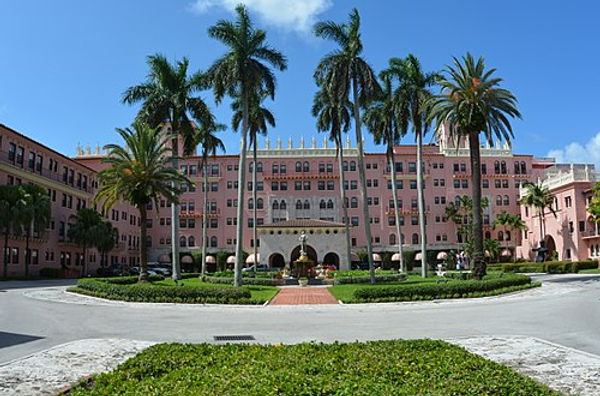
Arthur Vining Davis, whose brainchild was the Arvida Corporation, was responsible for modernizing the hotel. Opening the Boca Raton Club Tower in 1969, the building is still considerably taller than any other building in southern Palm Beach County. In addition, its famous "Boca pink" color has made it more famous than its stature of 300 feet (ninety-one meters) and twenty-seven floors, and it is commonly referred to as the "pink hotel". Arvida also constructed the resort's beach club in 1980, on the site that Mizner had intended the main hotel to stand on.
VMS Realty, Incorporated (Van Kampen, Morris, Stone), the successors to Arvida regarding ownership, purchased the property in 1983 and renamed it in 1988 as the Boca Raton Resort & Club.
In 2004, The Blackstone Group, a private investment firm, acquired the resort as part of its $1.25-billion acquisition of Boca Resorts, Inc., the publicly traded owner and operator of five Florida resorts. In February 2009, the Beach Club finished a $150 million renovation, while the cloister and tower rooms were redesigned in 2006. In May 2009, Hilton announced that the resort would be the 13th property to join The Waldorf Astoria Collection.
MSD Partners L.P., led by Michael Dell, purchased the Boca Raton Resort & Club on June 4, 2019. The new owners, as of 2020, have made a proposal to invest $75 million for renovations to the hotel, restaurants, and amenities. The property continued to be managed by Hilton under the Waldorf Astoria Hotels & Resorts brand until its departure in July 2021. As of July 12, 2021, the resort was renamed as The Boca Raton.

The resort first opened on Feb-ruary 6, 1926, as the 100-room Ritz-Carlton Cloister Inn. Origi-nally designed and built by Boca Raton's city planner, archi-tect Addison Mizner, who inten-ded Camino Real to be the main street of his new city, it was to have been one of two hotels, with the other being an oceanfront hotel. However, the Ritz-Carlton Investment Corporation became inVolved in the project and wan-ted the oceanfront hotel rede-signed, so construction began on the smaller and financially more viable 100-room inn on the west side of Lake Boca Raton.
The Boca Raton, south elevation. 501 East Camino Real, Boca Raton. Façade, port cochere, entrance courtyard, and fountain, as conceived by the Schultze & Weaver firm in 1930 for the conversion of Mizner’s Ritz-Carlton Cloister Inn into the Boca Raton Club. The fountain’s sculptural centerpiece was crafted by Italian sculptor Ettore Pellegatta, who first came to Florida to create artworks for James Deering’s Vizcaya. The entrance courtyard was the work of accomplished French landscape architect Jacques Greber, the green thumb known for the Stotesbury’s Whitemarsh Hall gardens.
....................................................................................................................................................................

https://www.newyorksocialdiary.com/the-boca-raton-history-afoot-benefits-historical-society/
Palm Beach Social Diary
January, 16, 2024
(Excerpted)
The Boca Raton: History Afoot benefits Historical Society
The Boca Raton, Palm Court. 501 East Camino Real, Boca Raton. In 2006, legendary French designer Thierry Despont’s modernistic makeover of the resort was highlighted by his installation of Infanta Margarita, a bronze sculpture by Manolo Valdes, pictured above, adapted from Velazquez’s Las Meninas (1656). More recently, the New York-based Rockwell Group reimagined the Palm Court, linking architect Addison Mizner’s original Ritz-Carlton Cloister Inn lobby, view left, with the central lobby of the Schultze & Weaver-designed Boca Raton Club (1930), view right. As well, the Rockwell Group’s aesthetic enlightened guest rooms and dining areas.
When Michael Dell’s MSD Partners LP rebranded the Boca Raton Resort & Club as The Boca Raton, it unveiled a more than $200 million renovation ensuring the platinum destination’s five-star status would outpace other name-only resorts that are privately owned, such as The Breakers and The Greenbrier. Even so, while White Sulphur Springs’ guests take to carriage rides and Palm Beach cliff dwellers dash about in their Bentley convertibles, The Boca Raton’s 200-acre enclave continues to attract a convergence of less visible Fortune 500 swells who prefer the purr of an Aston Martin and their Gulfstream G650 or Bombardier Challenger parked discreetly at Boca Raton’s nearby private airport.
First known as the Ritz-Carlton Cloister Inn when it was designed and built by Addison Mizner, it became the Boca Raton Club following architect Schultze and Weaver’s 300-room addition for then owner Clarence Geist. An exclusive “Sportsman’s Paradise,” Geist operated it as a “No photos-No publicity” private club. Later reincarnations, as the Boca Raton Resort & Club, included an association with the Waldorf-Astoria group during the Blackstone Group’s stint that brought in designer Thierry Despont for an au courant makeover.

Guests on horseback on Camino Real with the Ritz-Carlton Cloister inn behind, c. 1920s.
Just as Mizner’s Old World design was described as “history passing through the ages,” architect-designer Thierry Despont believed an architect’s mission was to be “a guardian of memories.” Although Mizner’s plans for Boca Raton collapsed much too soon, a century later his legacy endures in Boca Raton, as it does at Palm Beach. While Despont’s recent death recalls his exceptional work at Palm Beach and the brilliance of his out-of-this-world renovations, whether at The Plaza’s Palm Court, The Ritz in Paris, Fifth Avenue’s Cartier Mansion, or Claridge’s Hotel in London’s Mayfair.
When Despont’s bold floor plans, swatches, and sketches were first revealed, they were perceived by some as a detraction rather than an enhancement. In addition to the lobby, Despont reformulated the area where the resort’s two principal buildings intersected into an ultramodern Palm Court, topped by a transparent ceiling supported by palm-shaped steel structures made of Texlon.
Now, two decades since Despont’s progressive intervention at the Boca Raton Resort & Club made for a fascinating architectural paradigm, sparing the landmark from being frozen in time, the Rockwell Group’s “rethink” of the public areas and guestrooms has added new dimensions “to create cohesion and luxury.”
And what better way to explore a range of 20th-century design motifs beginning with Mizner’s adaptation of an 11th-century convent, along with additions by Marion Sims Wyeth and Treanor & Fatio, than by taking the local historical society’s walking tour of The Boca Raton. Along with an eclectic architectural history, the Boca Raton Historical Society’s guided ninety-minute walkabout tells of its illustrious past hoteliers, among them, Philadelphia utilities titan Clarence Geist, hotel and theatre magnate J. Myer Schine, and his wife Hildegarde Schine, one of Boca Raton’s earliest cultural philanthropists, Alcoa’s Arthur Vining Davis, Waste Management’s Wayne Huizenga, Chicago’s VMS Realty, and the Blackstone Group LP, Chairman Peter Peterson & CEO Stephen Schwarzman, who acquired Huizenga’s Boca Resorts packaged with several other resorts for $1.25 billion in 2004.

Ground plan. The shaded area indicates the original Mizner-designed Ritz-Carlton Cloister Inn, inspired by an 11th-century Spanish convent. The black-and-white, L-shaped outline depicts the Schultze & Weaver 1930 addition. [Boca Raton Historical Society]

Postcards, c. 1935. Boca Raton Club, “A Gentleman’s Club,” with the lakeside Cloister Inn.
[Boca Raton Historical Society]
1930'S BOCA RATON CLUB "A SPORTSMAN'S PARADISE. CLARENCE GEIST - OWNER


Boca Raton Club, 1930. Lobby view, east toward the lakefront. For the club-house’s décor, Clarence Geist retained Palm Beach-New York anti-quarian Omar Berberyan and Paul Chalfin, an interior decorator known for his work at Vizcaya as James Deering’s principal art advisor. Later, Chalfin became a Hollywood set designer.
[Boca Raton Historical Society]

Completed in December 1969, the original pink, 27-story, 250-room, lakeside Grand Tower was designed by New York’s Warner, Burns, Toan, and Lunde (WBTL) architectural firm with Toro-Ferrer of Puerto Rico as consultant. Considered the tallest building between Miami and Jacksonville, Arvida topped the tower with a presidential suite, restaurant, and an illuminated beacon. Lower right, the original Mizner-designed Cloister walkway stretches along Lake Boca Raton, enclosing what was once described as a garden.

Boca Raton Club, 1930. Lobby view, east toward the lakefront. For the club-house’s décor, Clarence Geist retained Palm Beach-New York anti-quarian Omar Berberyan and Paul Chalfin, an interior decorator known for his work at Vizcaya as James Deering’s principal art advisor. Later, Chalfin became a Hollywood set designer.
[Boca Raton Historical Society]