PBSCV1599

Gen. James Patton Anderson Camp 1599
Celebrating 34 Years 1992 - 2026
DIXIE COURT HOTEL
Palm Beach Post
Jan. 16, 1990
By Fred Lowery, Staff Writer
Stately No More West Palm`s 64-year-old Dixie Court Hotel Is About To Be Torn Down To Make Room For A New Justice Center.
After nearly 64 years of standing as a sentinel over the Palm Beach County Courthouse across the street, the Dixie Court Hotel soon will be retiring as a feature of the West Palm Beach skyline.
It is giving up its life for yet another element of downtown revitalization.
Along with the old Palm Beach County Jail and the Schooley Cadillac building, the once stately six-story Dixie Court, at 301 N. Dixie Highway, will be torn down later this month to make way for the county`s proposed $139 million Justice Center complex.
Plans for the complex include an 11-story courthouse, six-story Public Defender and State Attorney office building and central energy plant to be built on the 9 acres on the west side of Dixie Highway between First Street, soon to be renamed Banyan Bou-levard, and Fourth Street.
In a sense, the hotel will live on. The debris is scheduled to be used to form an artificial reef off Palm Beach after it is removed.
There won`t be any explosives used in the demolition, project manager Ben Cunning-ham said. ``That`s a bit dramatic and terribly expensive.``
Demolition crews, he explained, will enter each buildings, gut the interiors, then take them down from the top.
It will be an unceremonious end to a building that has stood as a witness to good times and bad, boom and depression in the city`s downtown.``More politics were handled in the (hotel) coffee shop than in the courthouse,`` reminisced one former city employee who used to lunch there.
``They call (demolition and replacement) progress, but I don`t know,`` said retired newsman Charlie Cabaniss, who spent 15 years in residence there.
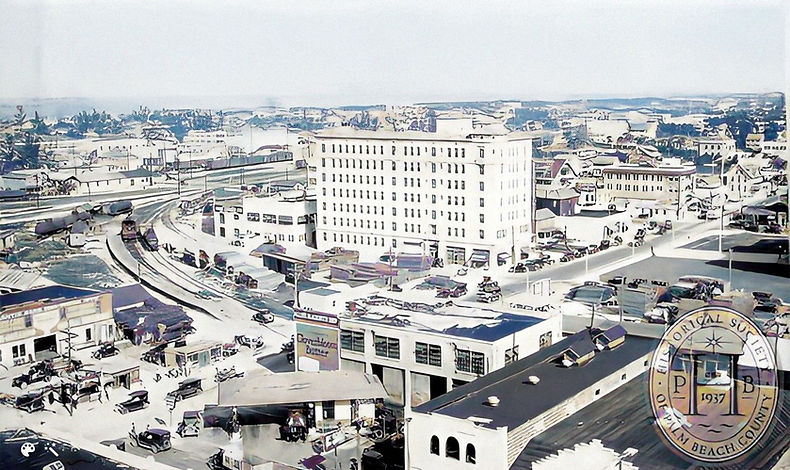
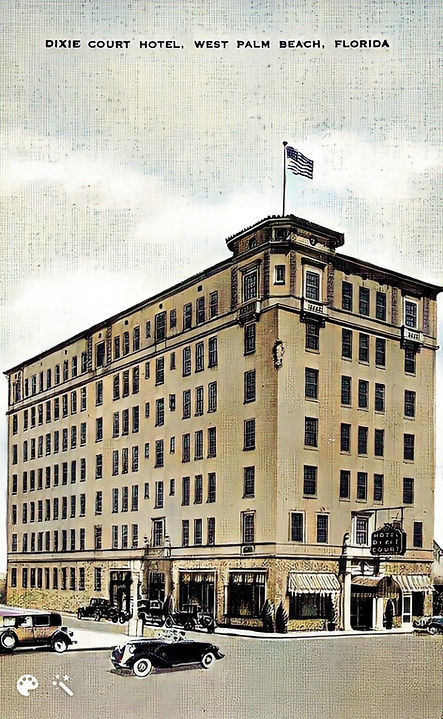
The Dixie Court Hotel (shown here around 1930) opened in 1926 and was 7 stories high with 132 rooms, a restaurant, and shops. It was razed in 1990 to make way for the county courthouse complex.
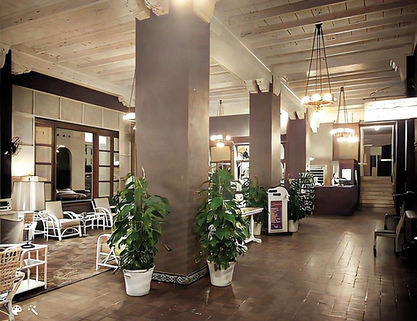
When this photo was shot of the Dixie Court’s lobby in 1984, the front desk clerks were still taking reservations. (Quincy Studios)
The Palm Beach Post
Sat. Jun. 6, 2015
Page D004
The seven-story Dixie Court Hotel, which welcomed its first guest on April 25, 1926, shared architectural DNA with the Palm Beach Town Hall, the Comeau Building on Clematis Street and Holy Trinity Episcopal Church on Flagler Drive.
All were designed by local Architects Henry Stephen Harvey and L. Phillips Clarke.
And the Dixie Court was apparently a sight to see. Each of its 117 rooms boasted a private bath, and its lobby had a high, pecky-cypress ceiling, a tile floor and brass-and-wrought-iron chandeliers.
A 1931 ad for the Dixie Court read: “Complete in every respect — quiet, comfortable bedrooms — alert, gracious service — a most tempting menu — all the niceties of appointment and attention so characteristic of the Florida-Collier Coast Hotels.”
Beginning in the 1960s, retirees moved into many of the Dixie Court’s rooms. In later years, the hotel provided shelter for clients served by county and state social pro-grams.
In 1984, the hotel hung up all its room keys, although a bank and legal offices rented space on the ground floor. Placed on the national list in 1986, the hotel was level-ed four years later, along with the nearby First Street jail and the Schooley Cadillac buildings.
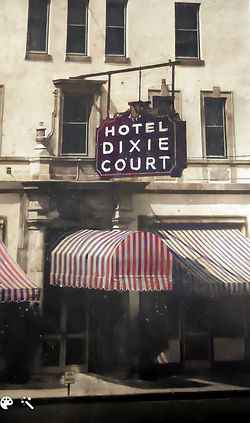
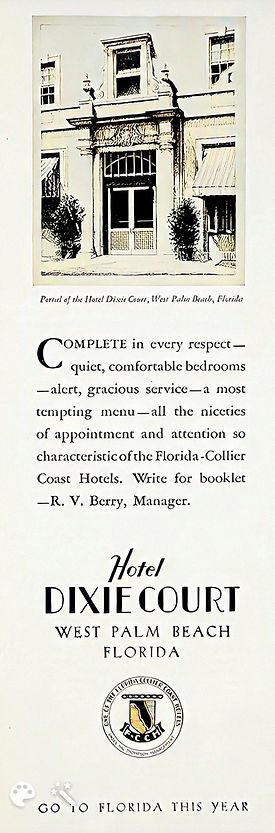
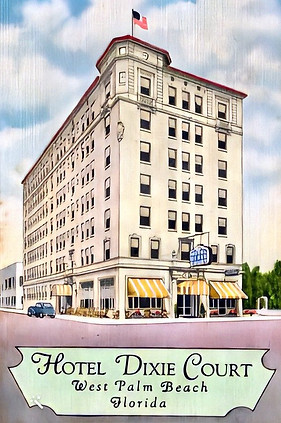
https://www.historic-structures.com/fl/west_palm_beach/dixie-court-hotel/
Ground was broken for the construction of the Dixie Court Hotel on April 22nd, 1925. Originally occupied by three frame dwellings, the hotel's site (the northwest corner of Althea Street (now Second Street) and Poinsettia Avenue (now Dixie Highway)) was destined for commercial development because of its location directly west of Palm Beach County Courthouse in downtown West Palm Beach. The hotel
was to be designed in a commercial adaptation of the Mediterranean Revival style by the noted West Palm Beach architectural firm of Harvey and Clarke and constructed by Wilcox Brothers, Inc., also of West Palm Beach. The developers, Court Properties, Inc., were organized by D. F. Dunkle, Attorney, former Mayor of West Palm Beach and President of the Palm Beach Guaranty Company.
A railroad embargo on construction materials delayed construction of the hotel which had been scheduled to open in December, 1925. The hotel was finally completed and opened on April 24th, 1926. The local press touted the seven-story building as a "skyscraper" as it joined the El Varno and the Pennsylvania as the newest of West Palm Beach's hotels. Designed as proposed in the Mediterranean Revival style, the hotel included 132 guest rooms, each with bath, a dining room, drug store and barber shop. The hotel's manager, John Jay Benson, advertised the operation as follows:
"The Dixie Court Hotel will operate the year round and will cater to both tourist and commercial trade. Located within a short walking distance of the central business section and strategically situated on the Dixie Highway, the owners of the hostelry believe they have selected an excellent site for a tourist and commercial business."
Henry Stephen Harvey and Louis Philips Clarke, architects of the hotel, were partners in the largest architectural firm in Palm Beach County in the 1920s. Clarke was from an old Palm Beach family (Clarke Avenue) and had been Harvey's student during architectural training at the University of Pennsylvania. Clarke brought Harvey to West Palm Beach and formed the partnership in April 1921. Among their major buildings in West Palm Beach were the Seaboard Air Line Railway Station, the Guaranty Building, the Comeau Building, the Wagg Building, the Pennsylvania Hotel and the Holy Trinity Episcopal Church. Harvey & Clarke also designed the Town Hall in Palm Beach.
The Dixie Court Hotel operated until the national depression of 1929 when the mortgagee, Adair Realty & Trust Company, a West Palm Beach company owned by D. F. Dunkle, obtained a final decree in the U. S. Southern District Court against Court Properties, Inc. In 1930 a masters deed was awarded to Florida-Collier Coast Hotels, Inc., with the Florida National Bank of Jacksonville as trustee. In 1936 the corporation reorganized and granted a deed of trust to the First National Bank of Jacksonville. In 1943 the hotel was deeded to Jefferson Standard Life Insurance Company, who in turn deeded it to E. M. Schuman and wife, et al. The hotel operated briefly during W.W.II and accommodated U. S. Army Air Corp trainees stationed at Morrison Field.
In 1950 E. M. Schuman, et al, deeded the hotel to Dixie Court, Inc. After a final judgment to quiet title in 1975 the hotel was sold to Ajit Asrani in January, 1976. Asrani operated the building as a commercial hotel until April 1984 and currently leases part of the first floor for a bank and legal offices.
The Hotel was demolished in 1990 for a new county courthouse.
Building Description
The Dixie Court Hotel is a seven-story, reinforced concrete and hollow clay tile and stucco building designed in a commercial adaptation of the Mediterranean Revival style. The principal (south and east) elevations of the building are distinguished by a three-part composition consisting of a one-story base, a five-story middle section and a one-story top or cornice section. A flat, built-up roof with a secondary barrel tile shed roof covers the building. A pyramidal-roofed tower located at the southeast corner of the building also crowns the building. The first story of the building is devoted to commercial retail space; the upper six stories include approximately 130 guest rooms and baths. The building occupies the southeast corner of a city block in downtown West Palm Beach.
The first story of the building is embellished by two elaborate classically derived entrances and large window openings with elaborate cast stone surrounds. The cast stone entrances consist of a pair of engaged columns in the Tuscan order which support a full entablature which is in turn crowned by a pair of urns. A cartouche is located directly above each doorway. Contemporary windows and doors have replaced their original counterparts although the original openings have been retained. The middle or five-story section of the building is eighteen bays wide on its south elevation and five bays wide on its east elevation. Fenestration is original double-hung sash, eight over eight and six over six, with cast stone sills. A prominent cartouche containing a fleur-de-lis motif is located at the southeast corner of the building between its fifth and sixth floors. The seventh or top story of the hotel includes three balconettes, quoin-like ornamentation and three jack-arched windows. The west elevation includes an exterior concrete stair; the north elevation a metal fire escape. A neon letter sign spelling out the name of the hotel (originally erected along the north roof line) has been dismantled and lies on the roof.
The first-story lobby retains its original tile floor, pecky cypress ceiling, brass and wrought iron chandeliers, switchboard, two wall crests and two Otis elevators. The east half of the lobby and dining room were recently remodeled to accommodate a bank tenant. A basement covers the west half of the building, with a boiler room on the first floor and a laundry room on the second floor. The remaining six floors include approximately 130 guest rooms and baths, although most of their original furnishings have been removed. An interior stair is located to the north of the elevator shafts.
................................................................................................................................................................................
Wikipedia
The Dixie Court Hotel was a historic hotel in West Palm Beach, Florida. It was designed by Harvey & Clarke and was built in 1926.
The hotel was sold in 1943.
On August 21, 1986, it was added to the U.S. National Register of Historic Places.
The building was destroyed in 1990 for the development of the Palm Beach County Courthouse complex. It was located at 301 North Dixie Highway.
History and description
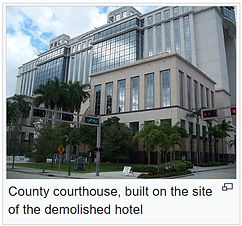
County courthouse, built on the site of the demolished hotel
Three residences formerly occupied the site that would later become the Dixie Court Hotel. John P. Johnson and Michael Zimny argued in the National Register of Historic Places (NRHP) registration form that "Althea Street (now Second Street) and Poinsetta Avenue (now Dixie Highway) was destined for commercial development because of its location directly west of Palm Beach County Courthouse in downtown West Palm Beach." Former West Palm Beach Mayor David F. Dunkle's Court Properties company developed the hotel, local architecture firm Harvey and Clarke designed the structure, and Wilcox Brothers, Inc. constructed it. The hotel was originally scheduled to open in December 1925, but construction was delayed for a few months due to a railroad embar-go.Costs for building the structure totaled about $300,000.
A seven-story, Mediterranean Revival architecture-style building, the Dixie Court Hotel opened on April 25, 1926 at 301 North Dixie Highway. Local press described it as a "skyscraper". Around this time, two other hotels, El Verano and the Pennsylvania, also opened in West Palm Beach. The interior of the Dixie Court Hotel included a barber shop, dining room, pharmacy, and 132 guest rooms, each of which contained a bath. In the aftermath of the 1928 Okeechobee hurricane, the building was among others to house refugees. Financial issues as a result of the Great Depression caused the hotel to cease operating, and its ownership changed several times, from Dunkle to Florida-Collier Coast Hotels, Inc. in 1930, to the First National Bank of Jacksonville in 1936, to Jefferson Standard Life Insurance Company in 1943, and later to E. M. Schuman, his wife, and other individuals.
During World War II, the hotel briefly re-opened to accommodate trainees of the United States Army Corps of Engineers, who were stationed at Morrison Field (now known as the Palm Beach International Airport). Schuman then deeded the Dixie Court Hotel to Dixie Court, Inc. in 1950, who in turn sold the hotel to Ajit Asrani in January 1976. Until April 1984, Asrani operated a commercial hotel but then leased portions of the ground floor to attorneys' offices and a bank. The Dixie Court Hotel was listed on the NRHP on August 21, 1986.
Despite the hotel's NRHP designation, the City of West Palm Beach approved a plan in January 1988 to purchase the site. Thereafter, the City intended to transfer the land to Palm Beach County, who would then demolish the hotel and construct a new courthouse in its place. The building was destroyed in 1990 for the development of the Palm Beach County Courthouse complex.
................................................................................................................................................................................